

Global properties of the energy landscape for machine learned potentials
Featured Article
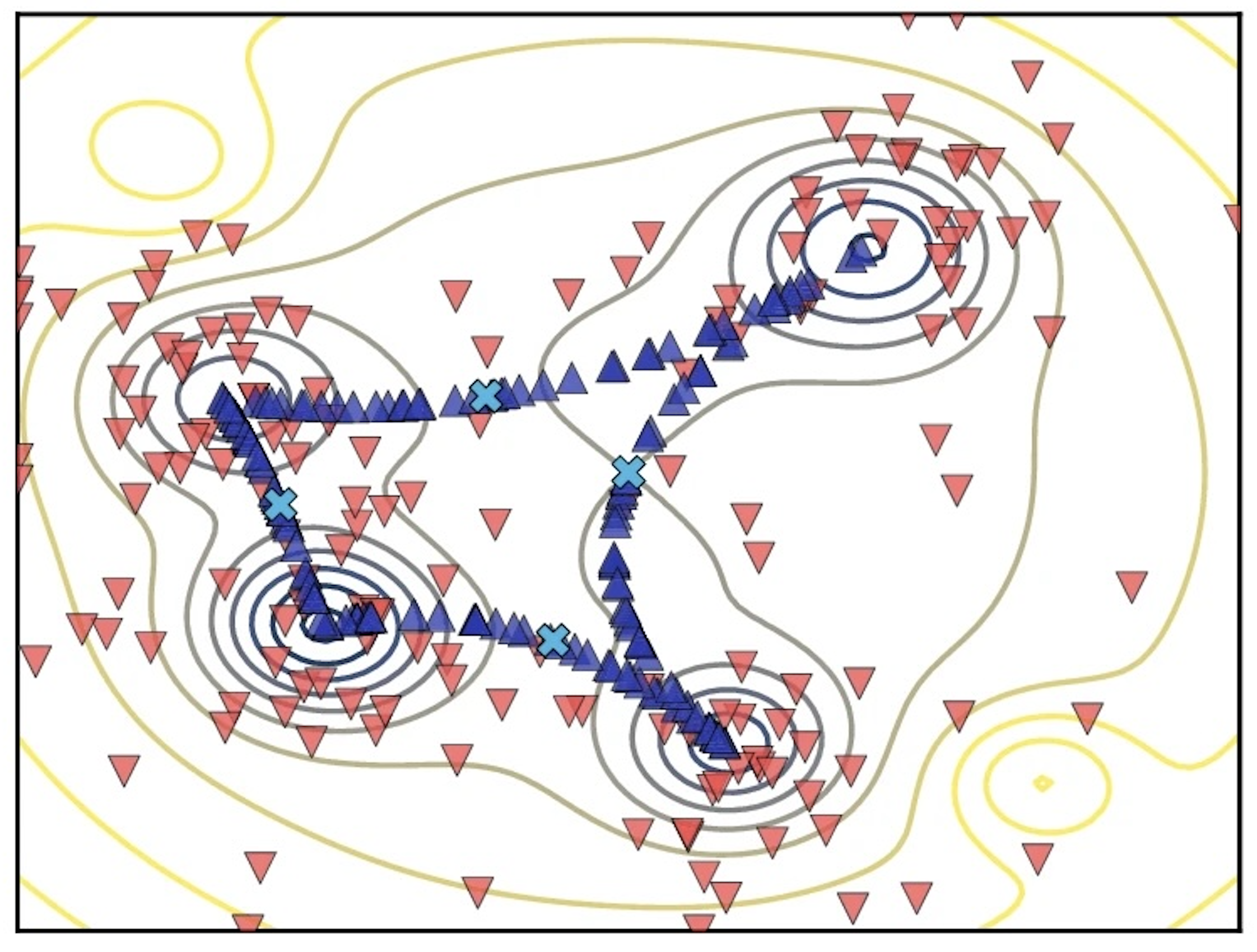
Delighted that our paper was selected to be featured article in Nature NPJ Computational Materials: where we introduce Landscape17, a dataset of complete kinetic transition networks (KTNs) for the six molecules of the rMD17 dataset, computed using hybrid-level density functional theory. Each KTN contains minima, transition states, and approximate steepest-descent paths, along with energies, forces, and Hessian eigenspectra at stationary points. This provides a step forward for testing MLIPs for validating next-generation MLIPs targeting reaction discovery and rate prediction.
Here's the Abstract from the paper
Abstract
Machine learning interatomic potentials (MLIPs) have achieved remarkable accuracy on standard benchmarks, yet their ability to reproduce molecular kinetics, critical for reaction rate calculations, remains largely unexplored. We introduce Landscape17, a dataset of complete kinetic transition networks (KTNs) for the six molecules of the rMD17 dataset, computed using hybrid-level density functional theory. Each KTN contains minima, transition states, and approximate steepest-descent paths, along with energies, forces, and Hessian eigenspectra at stationary points. We develop a comprehensive test suite to evaluate the MLIPs’ ability to reproduce these reference landscapes and apply it to state-of-the-art architectures. Our results reveal limitations in current MLIPs: all models considered miss over half of the DFT transition state paths and generate stable unphysical structures throughout the potential energy surface. Data augmentation with pathway configurations improves reproduction of DFT potential energy surfaces, resulting in significant improvement in global kinetics. However, these models still produce many spurious stable structures, indicating that current MLIP architectures face underlying challenges in capturing the topology of molecular potential energy surfaces. The Landscape17 benchmark provides a straightforward, lightweight, but demanding test of MLIPs for kinetic applications, and we propose this test for validation of next-generation MLIPs targeting reaction discovery and rate prediction.
Access Publication
Paper is Open Access from Nature NPJ Computational Materials
https://www.nature.com/articles/s41524-025-01878-x